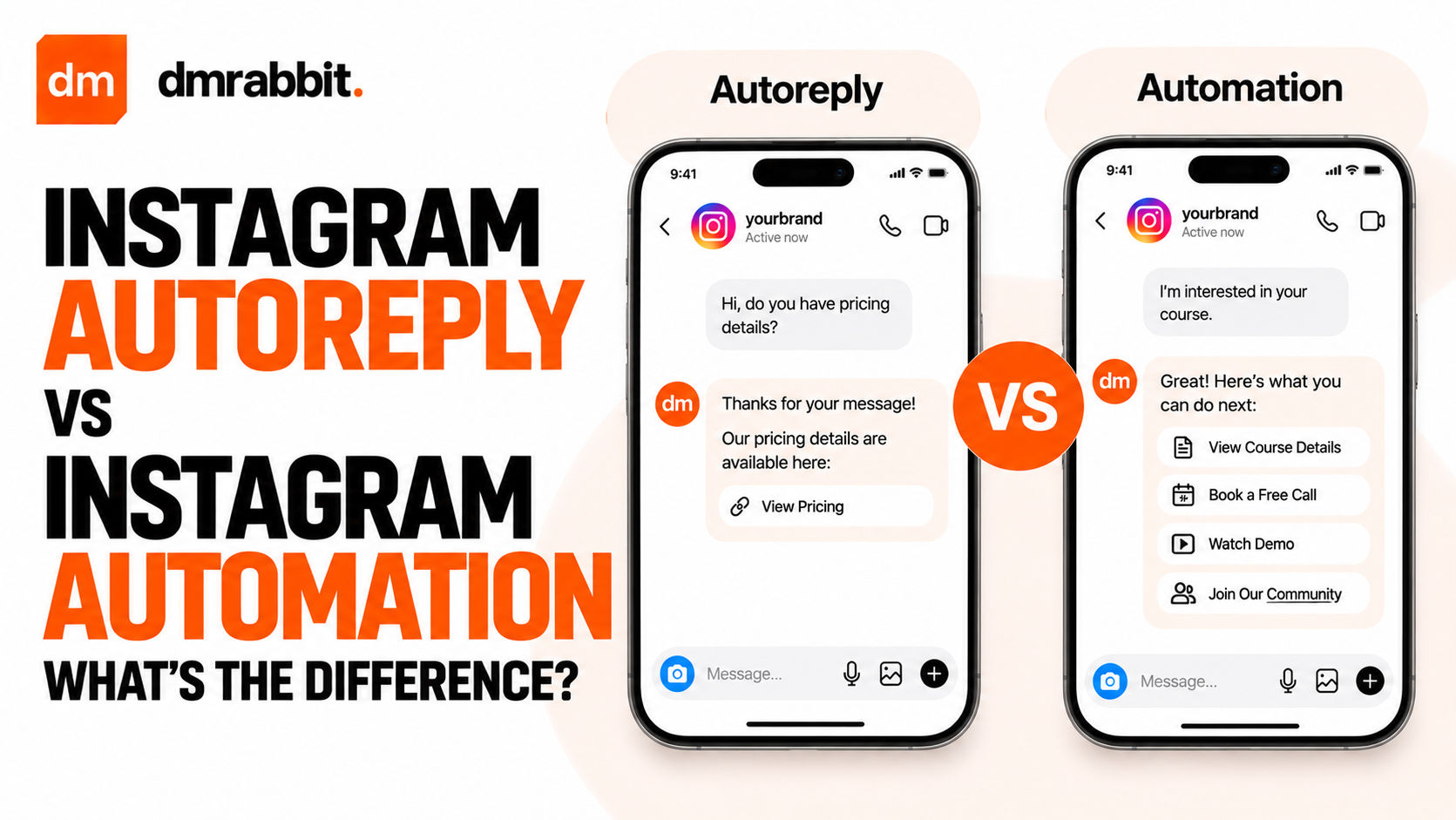
People use these two terms as if they mean the same thing, and most of the time, in casual conversation, that's fine. Search for either one and you'll land on mostly the same results, and most tools in this space don't bother separating them either. But there's a real, useful distinction underneath the overlap, especially once you're actually choosing a tool, writing content about one, or trying to explain to someone else what you're actually doing on your account.
The short version
Instagram autoreply refers to a specific action: an automatic response firing when a comment or DM matches a trigger you've set. It's a feature, not a category.
Instagram automation is the umbrella term. It covers autoreply, plus everything built around it, follow gates, bio pages, story-reply triggers, live comment handling, DM sequences. Autoreply sits inside automation as one piece, not the whole thing.
A useful comparison: "typing" relates to "writing a document" the same way autoreply relates to automation. Typing is one specific action inside the broader activity of writing. Autoreply is one specific action inside the broader activity of automating an Instagram account.
Why the confusion exists in the first place
Most tools in this space bundle several automation features together and market the whole bundle under one name, sometimes "autoreply," sometimes "automation," often both, depending on which page of the site you're on. That inconsistency trains people to use the terms interchangeably, in search behavior as much as in conversation. Someone typing "instagram autoreply" into Google is very often looking for the same basic outcome as someone typing "instagram automation," a way to respond automatically instead of manually.
Language follows usage, not precision, so this blending isn't really anyone's fault. It just means the words carry less specific meaning day to day than a strict definition would suggest.
What falls under "autoreply" specifically
Autoreply, narrowly defined, is any rule where a trigger produces an automatic response. The most common versions:
- A comment containing a specific word gets an automatic public reply
- A comment triggers both a public reply and a private DM
- An incoming DM gets an automatic first response, sometimes used to acknowledge a message outside business hours
- A reply to your Instagram Story containing a keyword gets an automatic response
All of these share the same basic shape: something happens, a rule checks for a match, a response goes out. That's the entire autoreply mechanism, regardless of which specific surface (comment, DM, story) it's applied to.
What falls under "automation" more broadly
Automation includes autoreply, but extends into things that aren't really "a reply" at all:
- A follow gate, which withholds a DM until someone follows the account, isn't a reply itself, it's a condition placed on one
- A bio page, hosting links and content outside the comment or DM flow entirely, isn't a reply at all
- Comment moderation, automatically hiding comments that match a word list, is automated, but it's suppression, not a response
- Multi-step DM sequences, where a first message leads to a follow-up days later based on behavior, go beyond a single trigger-and-reply exchange
None of these are "autoreply" in the strict sense. They're automation, because they run without manual input, but they're not built around the reply mechanism specifically.
A quick comparison
| Autoreply | Broader automation | |
|---|---|---|
| Core action | Trigger leads to a response | Trigger leads to any automated outcome |
| Typical scope | Comments, DMs, story replies | Adds follow gates, bio pages, moderation, sequences |
| Complexity | Usually a single rule | Can involve multiple connected rules or conditions |
| What it feels like to set up | Pick a trigger, write a reply | Pick a trigger, then decide what happens next, and next |
When the distinction is worth caring about
If you only need one specific thing. Someone who wants exactly one outcome, a comment triggers a reply, doesn't need to think about the broader category at all. "Autoreply" describes the whole requirement precisely.
If you're comparing tools. Some products are built narrowly around autoreply as the entire feature set. Others are full automation platforms where autoreply is one module among several, sitting alongside follow gates, bio pages, and moderation tools. Paying for, or navigating, a broad automation platform when all you wanted was autoreply means dealing with complexity you're not using.
If you're trying to describe your own setup to someone else. "I've got autoreply set up on my product posts" is a clear, specific claim. "I automated my Instagram" could mean almost anything, from a single comment trigger to a fully connected system of follow gates and sequences.
If you're writing or reading content about either. A piece titled "Instagram automation" that only ever discusses comment replies is really an autoreply article wearing a broader label. Knowing the distinction helps you tell whether a resource actually covers what you're looking for.
How dmrabbit fits into both terms
dmrabbit's core mechanism is comment-triggered autoreply paired with an automatic DM, that's the autoreply piece, and for most people setting up an account, it's also the main thing they came for. Built around that core sit broader automation features: a native follow gate, a bundled bio page, and story-reply and live-comment triggers, which extend the product past autoreply into the wider automation category.
In practice, most people start using dmrabbit because they want autoreply specifically, an instant response to a comment, and discover the rest of the automation toolkit once that's already working.
FAQ
Is Instagram autoreply a type of Instagram automation?
Yes. Autoreply is one specific feature within the broader category of Instagram automation, which also includes things like follow gates, bio pages, moderation, and story-reply triggers.
Do I need a full automation platform if I only want autoreply?
Not necessarily. Some tools are built narrowly around comment-triggered autoreply specifically, which can be simpler to set up and reason about than a broader automation platform if that's genuinely all you need.
Is a follow gate part of autoreply or automation?
Automation. A follow gate is a condition placed on a DM, not a reply itself, so it falls outside the strict definition of autoreply even though it's commonly bundled with autoreply features in the same tool.
Does dmrabbit offer autoreply, automation, or both?
Both. Autoreply, an automatic response to a trigger, is the core feature, alongside broader automation tools like a follow gate, a bio page, and story-reply triggers.
For a full comparison of Instagram automation tools, see our complete 2026 guide.
Want to see autoreply and automation working together? Start free with dmrabbit.