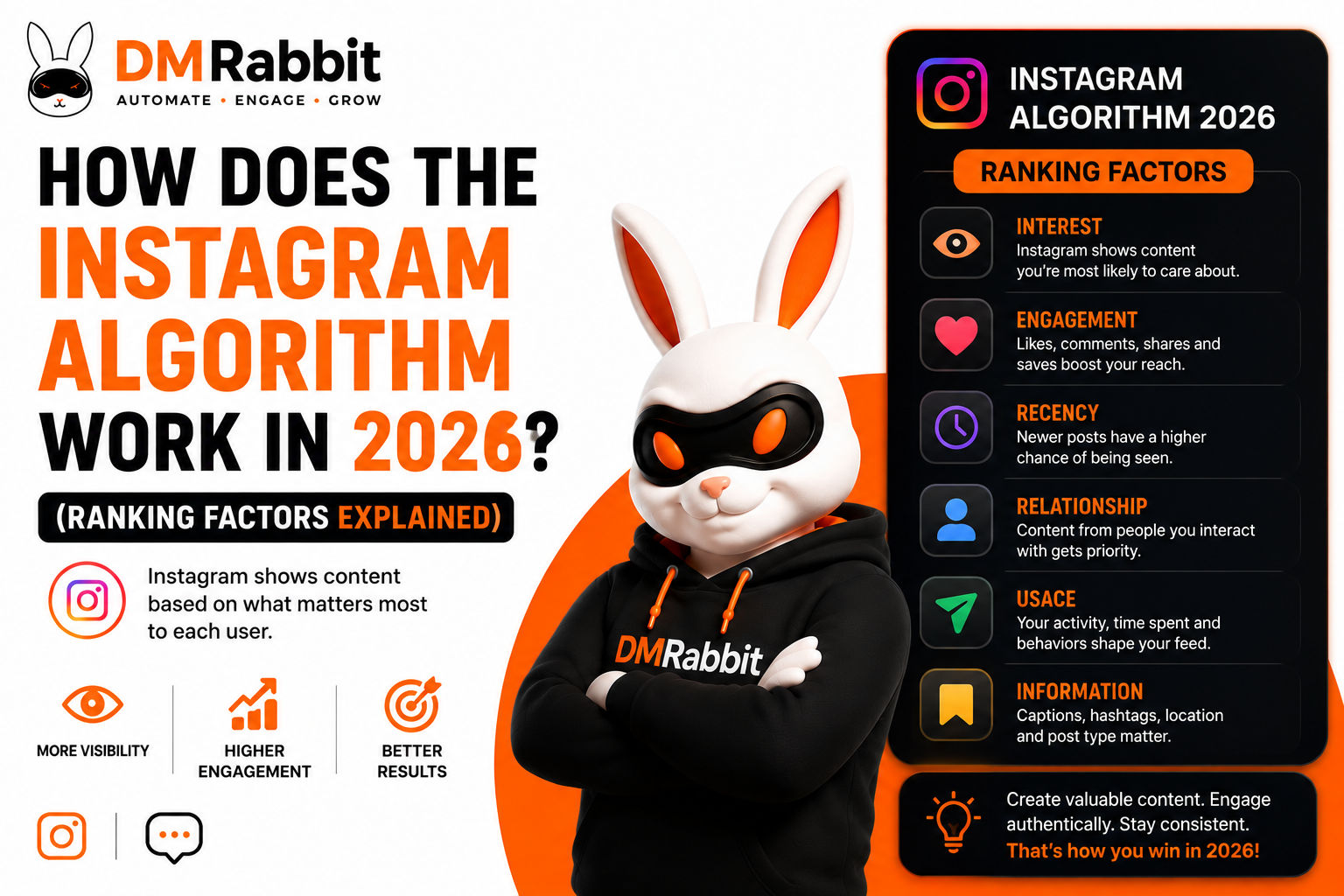
Short answer: Instagram doesn't run on one algorithm, it runs on separate AI ranking systems for Feed, Reels, Stories, Explore, and Search, each weighing signals differently. Across all of them, Instagram head Adam Mosseri has confirmed the three factors that matter most: watch time, sends per reach (how often people DM-share your content), and likes per reach, with sends carrying roughly three to five times more weight than likes. A March 2026 update added a fourth factor with direct implications for automation: two-way conversation, meaning how quickly and consistently you reply to comments and DMs, is now a ranked signal in its own right.
Here's what the 2026 data actually confirms, and what it means for how you run your account.
Instagram uses multiple algorithms, not one
Feed, Reels, Stories, Explore, and Search each have their own ranking system, scoring content based on different signals for that specific surface. A Reel that performs well in the Reels tab may barely register in your followers' Feed, and vice versa. This is confirmed directly by Instagram leadership, not speculation, understanding which surface you're optimizing for matters as much as the content itself.
The three confirmed ranking factors
Watch time is the single most important signal. How long someone stays on your content, and whether they rewatch it, is the strongest indicator Instagram uses to decide whether to show it to more people. This applies across formats, not just Reels.
Sends per reach is the strongest factor for reaching new people. When someone DMs your post to a friend, Instagram reads that as a strong, personal quality signal, one Mosseri has said carries three to five times more weight than a like when deciding whether to push content to people who don't already follow you.
Likes per reach still counts, but weighs less than before. Likes remain a signal, just a comparatively weak one next to watch time and sends. Saves have also become meaningfully more important than likes, since saving something signals lasting value rather than a passive reaction.
The 2026 update that matters most for automation
In March 2026, Instagram confirmed that two-way conversation, replying to comments and DMs quickly and consistently, is now a directly ranked signal, not just a courtesy that happens to build goodwill. Accounts that have genuine back-and-forth exchanges with their audience get pushed higher in that audience's Feed and Stories tray.
This changes the calculation around response speed. A slow reply to a comment isn't just a missed individual conversion anymore, it's a weaker signal sent to the algorithm itself, on every single interaction, compounding across your account over time. An account that replies to every comment within seconds is training the algorithm to treat every future post more favorably, not just closing one sale.
Why overall engagement is declining industry-wide
A large-scale 2026 analysis of 35 million posts found overall engagement down roughly 24 percent year over year, sitting at around 0.48 percent, with images performing weakest at roughly 0.33 percent. This isn't a sign that content quality has dropped, it's the result of content volume growing faster than human attention, with more of the real engagement happening privately (DM shares, saves) in ways public engagement metrics don't fully capture. Views, not just likes and comments, became Instagram's primary unified performance metric across formats in 2026 partly for this reason.
What actually moves the needle in 2026
Original, native content wins. Instagram actively favors content that isn't visibly recycled from another platform, watermarks from other apps are treated as a negative signal.
Consistency and topic clarity help discovery. Instagram's content-understanding systems now analyze visuals, on-screen text, and audio, not just captions and hashtags, so content needs to actually match what it claims to be about.
Multi-format accounts get more overall favor. Mixing Reels, carousels, and Stories tends to perform better than relying on a single format exclusively.
Fast, consistent replies are now a direct ranking input, not just a conversion tactic. This is the point most creators and businesses haven't caught up to yet.
The practical takeaway
Understanding the algorithm doesn't mean gaming it, Instagram's own guidance is that the system adjusts constantly to reward genuine engagement, not shortcuts. But one specific, controllable factor stands out from the rest: response speed to comments and DMs is now something the algorithm measures directly, which means the businesses replying instantly, at any volume, aren't just converting individual leads faster. They're compounding an algorithmic advantage on every post, automatically.
What this means for your posting
Instagram's 2026 algorithm rewards watch time, DM shares, and saves more than likes, and separates ranking by surface rather than using one universal system. The newest, most actionable shift is that two-way conversation, how consistently and quickly you reply to comments and DMs, is now a ranked signal in its own right. For businesses that can't manually reply to every comment instantly, that's a direct case for automation, not just as a customer experience improvement, but as a measurable input into how the algorithm treats your account.
FAQ
What are the top three Instagram ranking factors in 2026? Adam Mosseri has confirmed watch time, sends per reach (DM shares), and likes per reach as the three most important signals, with sends carrying roughly three to five times more weight than likes.
Does replying to comments actually affect the Instagram algorithm? Yes. A March 2026 update confirmed that two-way conversation, meaning how quickly and consistently an account replies to comments and DMs, is now a directly ranked signal, not just a factor that indirectly builds engagement.
Why has Instagram engagement declined across the board in 2026? A large-scale analysis of 35 million posts found engagement down roughly 24 percent year over year, attributed mainly to content volume outpacing available attention, with more real engagement shifting to private channels like DMs and saves that public metrics undercount.
Is there one universal Instagram algorithm? No. Instagram uses separate ranking systems for Feed, Reels, Stories, Explore, and Search, each weighing signals differently for that specific surface.
For a full comparison of Instagram automation tools, see our complete 2026 guide.
Reply to every comment and DM instantly, and let the algorithm notice. Start free with dmrabbit: official API, no credit card required.